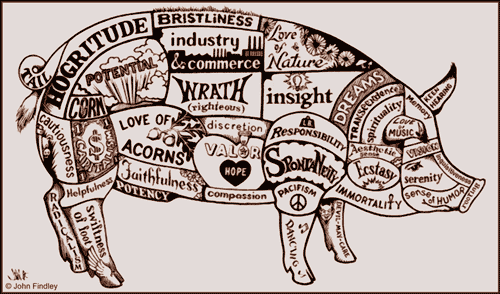
A Trespass of Swine

vitruvian swine

the Porkopolis blog

Considerations of humanity and hogritude, because an insufficiency of pigs is one of the great faults of all that the gods have made manifest to man.

National Pigs-in-a-Blanket Day

Saturday, April 24th is National Pig-in-a-Blanket Day in the United States. To celebrate, Porkopolis.org is offering a favorite variety, the Mangalitza. This is not a food entry on cabbage rolls or informal U.S. cuisine; it’s a blanket statement and a shaggy hog story…

Literally, Pigs in Blankets

Or shear swine, all cry and no wool;

- Samuel Butler. Hudibras, pt. I, canto I, l. 852

To “shear your pig” is a common euphemism for an act of futility. As most any farmer will tell you, you’ll get a lot of noise for very little wool if you try to shear most any pig.

And, as noted above, no less an authority than the English writer, artist and satirist, Samuel Butler (1835-1902), has even weighed in on the shearing of pigs. Clearly Butler’s travels never took him near to the Curly Coat pigs of Lincolnshire in the east of England, or to Austria and Hungary, home of the of Mangalitza pigs. Warm sweaters could easily be knitted from the sheared “wool” of these pigs, they are literally, pigs in blankets.

mangalitza pig 1

Big, Fat and Rather Sheepish

Seen from a ways off Mangalitza pigs bear a striking resemblance to sheep – a big fat sheep. A casual glance from a non-husbandman and you would have no idea that they are pigs, that is until you get a view of their snouts. Then you see they are pigs, not posers. Root on in this post…

Poetry Updates for April 2010

porky pig poetry update

In the Porkopolis.org Library, poetry updates for mid-April include: an eccentric Anglican; a moveable feast; diction adapted to a certain class of readers; lawyers, not pigs in time of famine; hogs and men hunted and penned in an inglorious spot; and lastly, perpetual promises, but to no good ends.

The poet Robert Peters discusses Gyp, the big black pig of Robert Stephen Hawker (1803-1875) an eccentric Anglican clergyman.

The Art Museum has added Pieter Brueghel the Elder’s “The Land of Cockaigne.” This painting’s special moveable feast, a ready-to-eat pig, also attracts Robert Peters’ attention.

For the poet Hale Chatfield, Porky Pig is the point of departure for a look at the perpetual promise and beautiful hopelessness of language and life.

Root on in this post…

Russell, Gregory, Yeats and the Black Pig

All over Ireland there are prophecies of the coming rout of the enemies of Ireland, in a certain Valley of the Black Pig, and these prophecies are, no doubt, now, as they were in the Fenian days, a political force.

from A Note on “The Valley of the Black Pig” in The Wind in the Reeds, (1899) by W.B. Yeats

Black Pig near Knocknarea Mountain by Porkopolis.org.

A Pig and A Bit of Doggerel

A new work of art has been added to the Porkopolis.org Art Museum. For me it is also the point of departure for considering how friends might utilize humor as a tension reliever and a coping mechanism for momentarily dispelling their concerns over the consequential matters that embroiled their days. Here, the humor employed is sarcasm and the implementation is through a humorous drawing of a pig and bit of doggerel.

The drawing and text, which are detailed below, are the kind of humorous device any group of family or friends might use. Yet the devisor here is the Irish nationalist, writer and artist George William Russell (Æ or A.E.). The subjects of the drawing are a black pig and Russell’s life-long friend, the poet and fellow Irish nationalist William Butler (W.B.) Yeats. And the drawing was sent as part of a comradely and congenial letter to the dramatist and folklorist Isabella Augusta, Lady Gregory, a mutual friend of Russell and Yeats. Root on in this post…